Posts

Showing posts with the label Perseverance

#RDaudio: Procrastination

Image
In this brand-new audio recording, the first in a series of lockdown conversations we're calling #RDaudio , Dr Steve Joy (Head of Researcher Development, University of Cambridge) and Katie D'Arcy (freelance careers advisor and researcher development specialist) talk about the challenges of procrastination and how to overcome it.

Resilience (5 of 5): having a strategy for cultivating resilience

Dr Emily Troscianko  &  Dr Rachel Bray Occasionally life surprises us with an event so momentous that it seems to change everything – whether as painfully as bereavement or as beautifully as falling in love. But even events at this scale do not, in fact, change everything. Life has a habit of reverting to the easiest equilibrium: negative feedback  kicks in, and old habits creep back in, whether comfortingly or frustratingly. One thing this means is: don’t expect magic bullets. Even winning the lottery will not remove all your life’s problems (though it may remove some, and create others). The other thing it means is: it’s harder than you think to throw your life into disarray. Investigating, trying out, and even committing to a new career path is not all-or-nothing, nor all-at-once. Real change takes energy, and big turning points often come rather late in the process. Our recent post on Plan A and Plan B  suggested that it’s a mistake to imagine a discre...

Resilience (4 of 5): your working identities

Dr Emily Troscianko & Dr Rachel Bray ‘No career change materializes out of the blue. […] Since we are many selves, changing is not a process of swapping one identity for another but rather a transition process in which we reconfigure the full set of possibilities.’ (Ibarra, Working Identity, 2004, p. xi)  If you’ve begun to try any of the exercises we suggested in the previous post in this series on resilience, you’ll already understand that exploring your resilience goes right to the heart of who you are. There are several traps lurking in the realm of work and identity. The first is to believe that we should all know who we are (after all, surely we’ve been alive long enough to have found out?), and that doing things like researching new career possibilities means merely finding ways to put that peerless self-knowledge into practice. Another slightly subtler trap is to believe that there is a ‘real you’ submerged somewhere deep inside, to be uncovered through the hard d...

Resilience (3 of 5): distinguishing between assumptions and reality

Dr Emily Troscianko  &  Dr Rachel Bray Expectations interfere with understanding – they cause us to misread, misdiagnose, or simply to miss what is really happening. That’s even more true when the expectations that you’re carrying around with you originated with others (your family, friends, peers, teachers, mentors…). Indeed, in a podcast series on ‘Overcoming a sense of academic failure’, this was one of the threads that ran most strongly through our contributors’ reflections on their own professional paths. It can happen so seamlessly: your teachers want you to get to a good university, your lecturers want you to get a good degree, your supervisor wants you to get your doctorate, your PI wants you to publish good papers. Each of these ambitions directly supports the next, and all of them make a good deal of sense within their own system. (Of course they do: most of the time they are put forward by the people who run the system – the academics who stayed and who ‘mad...

Resilience (2 of 5): The feedback dynamics between you and academia

Image
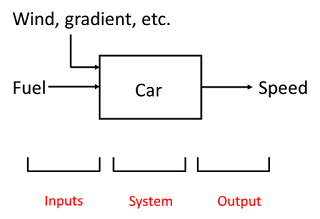
Dr Emily Troscianko and Dr Rachel Bray In the first post in this series on resilience, we thought about how you and the academic environment interact. We considered some of the benefits and drawbacks of working in academia, and some of the personal characteristics that might make you more or less resilient in the face of its stresses. In this post, we offer a way of modelling these interactions in more visual, dynamic terms. Seeing things drawn as well as written can be helpful in understanding the underlying structures (it’s not just about me…), and in adopting a fresh perspective on choices available to you. Once you start thinking of yourself, your life, and the world as a feedback system, it can become an addictively satisfying way of seeing the bigger picture. Feedback dynamics are fundamental to pretty much any system you can think of – biological, technological, institutional, psychological… This means that grasping some feedback basics is crucial to understanding how ins...

Resilience (1 of 5): does academia complement or conflict with who you are?

Emily Troscianko and Rachel Bray Everything in life has its stresses, and academia isn’t necessarily more stressful than any other professional sector. But academia does have particular contours of cost and benefit, some of which we readily talk about while others are easier to ignore. Opening a conversation is often the key to igniting personal reflection and action, and it’s in this spirit that we offer six posts over the coming months on the linked topics of resilience, self-awareness, and identity in academia. They address two simple questions: If staying in academia is so hard, why do so many people want it?   If you do want it, how can you work towards it whilst  preserving your sanity ?  And they propose and elaborate on two simple answers:  Because it still offers so much that is intellectually and personally appealing.   By being honest with yourself about what it's really like and what it rea...

Passion & perseverance: what makes the difference in academia

Dr Steve Joy ‘You need to love what you do, so seek out projects that challenge you and make you excited to go to work!’ This post is based on the results of project I co-conducted with Dr Sharon Saunders from Cambridge’s Researcher Development Programme . We asked academics & PIs to answer, in no more than one sentence, the question, “What advice would you give to a postdoc looking to make it in academia?” The rationale for the project came from the various national & Cambridge-specific evidence which has consistently shown that the advice most wanted by those aspiring to make it in academia is – quelle surprise – from those who have already made it themselves. Yet a wide range of factors mean that, in reality, it can be difficult to access advice from outside one’s own immediate group & hence to hear a multiplicity of viewpoints. The intention was never that individual sentences should stand alone – as one respondent put it (with a not-so-subtle hint of sarcasm)...

Reflections: Cumberland Lodge & the theme of perseverance

Dr Steve Joy Last week, I had the pleasure of being a guest at Cumberland Lodge , an academic retreat that is elegantly sequestered in the Great Park, Windsor. Just to be at this gloriously peaceful venue felt restorative for mind & body. And my reason for being there? I was speaking at this year's Life Beyond the PhD conference. Here are some reflections on that experience - particularly around the theme of perseverance . The conference was attended by PhD students & postdocs - at all career stages, from all disciplines, from institutions all over the UK. The aim was to prepare participants for 'an increasingly interdisciplinary academic life' as well as to show them 'that PhDs have demonstrable value both inside and outside academia'. I was there, you won't be surprised to learn, to contribute to the latter objective. And, happily, I was the bearer of good news: evidence shows that people with PhDs are employable outside the academy, provided that...